
A dashboard warning light deserves attention before the MOT, but the answer is not simply that every illuminated symbol fails. The tester checks particular systems under rules that depend on the vehicle. Your first task is to identify the message and decide whether the car is safe to use.
This guide covers ordinary cars tested in England, Scotland and Wales. Northern Ireland uses its own testing arrangements. For your car’s exact symbols and instructions, use its handbook.
Identify the light before drawing a conclusion
Many lamps illuminate briefly when the ignition is switched on as part of a self-check. That can be normal. A lamp that stays on, flashes or appears while driving needs to be interpreted using the manufacturer’s instructions. A service reminder, an information message and a fault warning are not interchangeable.
Record the symbol, colour, message and when it appears. Does it go out after starting? Is it steady or flashing? Did the car lose power, make a noise or behave differently? If useful, take a photograph once safely parked. Do not try to photograph the dashboard while driving.
The Highway Code’s maintenance guidance says to stop and investigate persistent warning lights or those appearing while driving. Follow the handbook’s stopping instructions. If braking or steering changes, or the car may be unsafe, seek help and arrange suitable recovery rather than driving to an MOT appointment.
Which warning lights can cause an MOT failure?
| System | MOT distinction |
|---|---|
| Engine management light (MIL or EML) | Where the check applies, an inoperative lamp or one indicating a malfunction is a major defect. |
| Anti-lock braking system (ABS) | A warning device that does not operate, or indicates a system malfunction, is a major defect where ABS is fitted. |
| Airbag / supplementary restraint system (SRS) | A lamp indicating a system malfunction is a major defect. A passenger-airbag-off indicator is not, by itself, this fault. |
| Electronic stability control (ESC) | A lamp indicating a system malfunction is a major defect. Distinguish a malfunction from a normal indication that the system has been switched off. |
| Tyre pressure monitoring system (TPMS) | On cars covered by the check, a system malfunction is a major defect. A low-pressure indication does not automatically mean the monitoring system has failed. |
“Major” means an MOT failure. The table summarises the warning-device checks, not every possible fault in these systems. A brake, tyre or steering defect can matter independently of its warning lamp.
Engine management lights: the vehicle’s age matters
For ordinary petrol cars, including hybrids, with four or more wheels and no more than eight passenger seats, the MIL check applies from a first-use date of 1 July 2003. For diesel vehicles, including hybrids, with four or more wheels, it applies from 1 July 2008.
Gas, bi-fuel and unusual vehicle types have additional rules and exceptions in section 8 of the DVSA manual. Check the applicable category rather than transferring a date from a different vehicle type. Being outside a particular lamp check does not make an engine fault harmless.
A hybrid’s exemption from the metered exhaust emissions test does not automatically exempt it from the MIL check. For related preparation, see MOT emissions tests and repairs.
A tyre-pressure light needs the right diagnosis
The TPMS inspection generally applies to M1 passenger cars first used on or after 1 January 2012, with specific exceptions in the manual. Check actual tyre pressures and condition using the handbook’s instructions. Do not assume that resetting the display resolves a puncture or an electronic fault.
Our TPMS guide explains the distinction between pressure loss and a monitoring fault, including the scope of the MOT check.
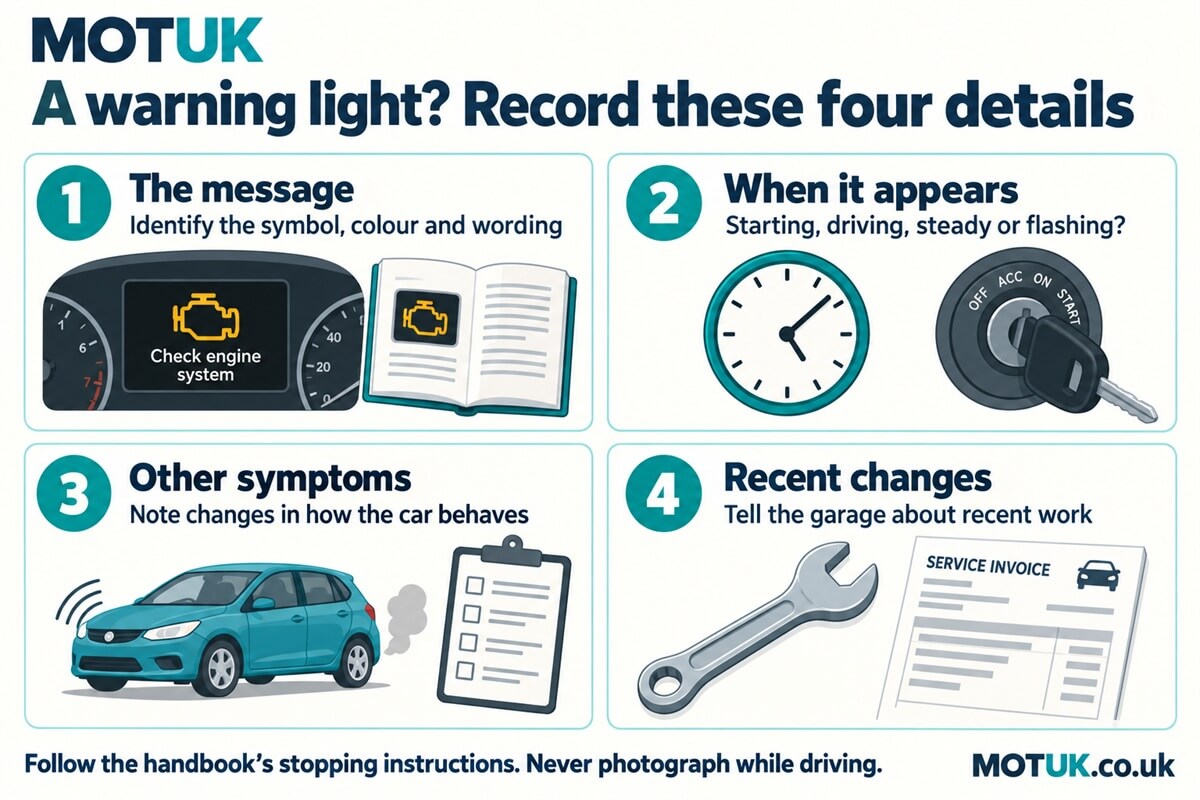
What to tell the garage
- The exact warning and whether it appears before starting, after starting or during a journey.
- Any change in braking, steering, power, temperature or noise.
- Recent work, a flat battery or other events before the warning began.
- Whether the fault is constant or intermittent, and any pattern you have observed.
- Your MOT expiry and whether you need advice on moving the vehicle safely.
Ask for diagnosis, the proposed repair and confirmation that the system has been checked afterwards. A fault-code reading is useful evidence, but it does not always identify a failed part on its own. Clearing codes or covering a lamp is not a repair.
Leave airbag systems and hybrid or electric high-voltage equipment to appropriately trained technicians. For straightforward owner preparation, use our pre-MOT checklist.
Sources and review
Reviewed 10 October 2026 against the DVSA MOT inspection manual: brakes and ABS, tyres and TPMS, SRS and ESC and engine MIL. Rules do not replace the vehicle manufacturer’s safety instructions.