
Shock absorbers control suspension movement after a wheel meets a bump. The springs support the vehicle’s load; the dampers help stop that movement continuing unchecked. Worn or damaged suspension can affect handling and tyre contact with the road.
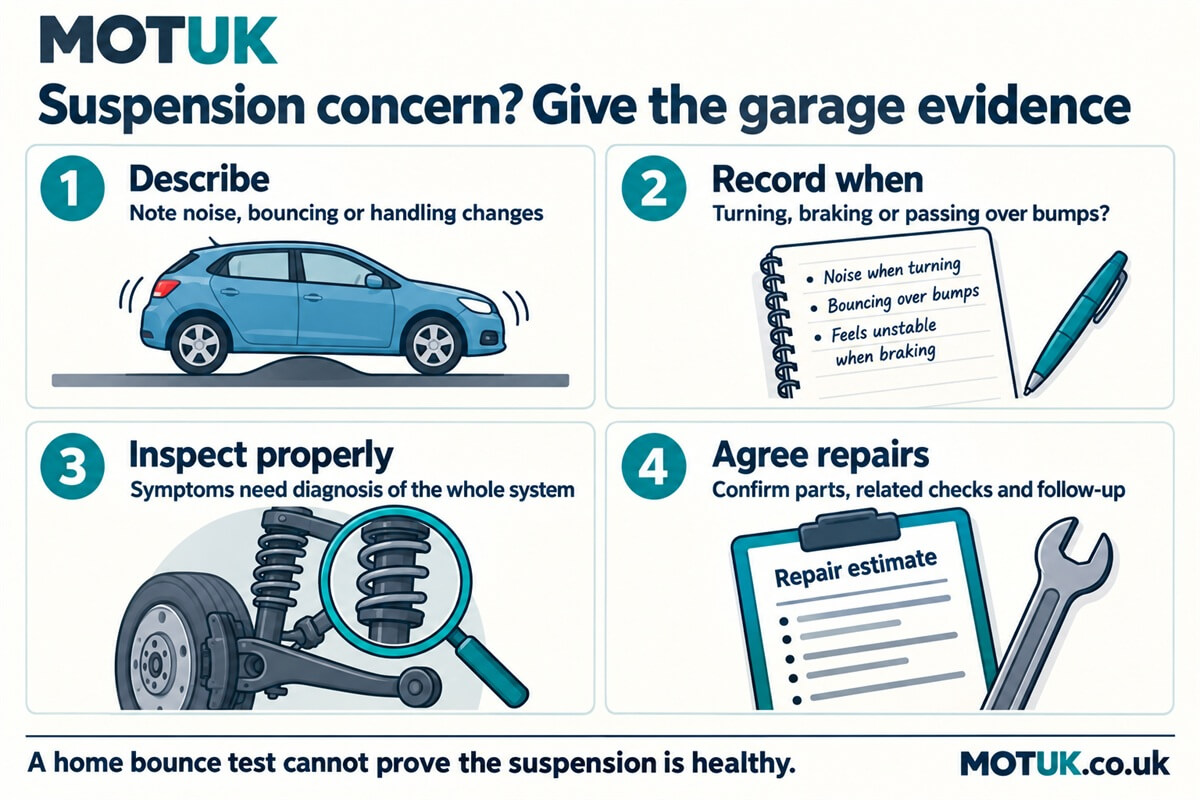
Signs that deserve an inspection
Repeated bouncing, a new knocking noise, unusual body movement, uneven tyre wear or a noticeable change in steering can justify a suspension check. These symptoms do not diagnose a shock absorber on their own: tyres, springs, joints, bushes and other components can produce similar effects.
If the car suddenly handles unpredictably, a corner sits unusually low, or you suspect a broken or loose component, stop somewhere safe and arrange professional advice or recovery. Do not wait for the next MOT.
Can you check dampers at home?
You can note symptoms and look for obvious damage from a safe position with the car parked. Do not crawl underneath a vehicle supported only by a jack. A simple body-bounce test cannot prove that a modern suspension system is healthy.
Keep a record of when the noise or handling change occurs, such as over bumps, during braking or while turning. Give that information to the technician. Avoid repeated road tests if the car may be unsafe.
What the MOT checks
The tester assesses suspension condition and security using the relevant inspection procedure. A seriously leaking damper, negligible damping effect or insecure attachment can cause a failure. A slight film of oil is not automatically the same as a serious leak. The complete component and its operation matter.
An MOT pass does not predict how long a damper will last. An advisory may identify wear that needs monitoring or repair before the next annual test. See what an MOT covers for the wider inspection.
Getting repairs right
Ask the garage to identify the defective part, assess the other side of the axle and explain whether replacement in pairs is appropriate for your vehicle. Confirm the correct specification, especially where adaptive or electronically controlled suspension is fitted.
The estimate should identify parts, labour and any necessary alignment or calibration. Suspension springs store significant energy, so replacement is work for someone with suitable training and equipment. Keep the invoice and arrange a retest if the defect caused an MOT failure.
Reviewed 10 October 2026. MOT guidance applies to England, Scotland and Wales unless stated otherwise.